
Church of Our Lady of the Assumption, La Ciotat
Church of Our Lady of the Assumption, La Ciotat
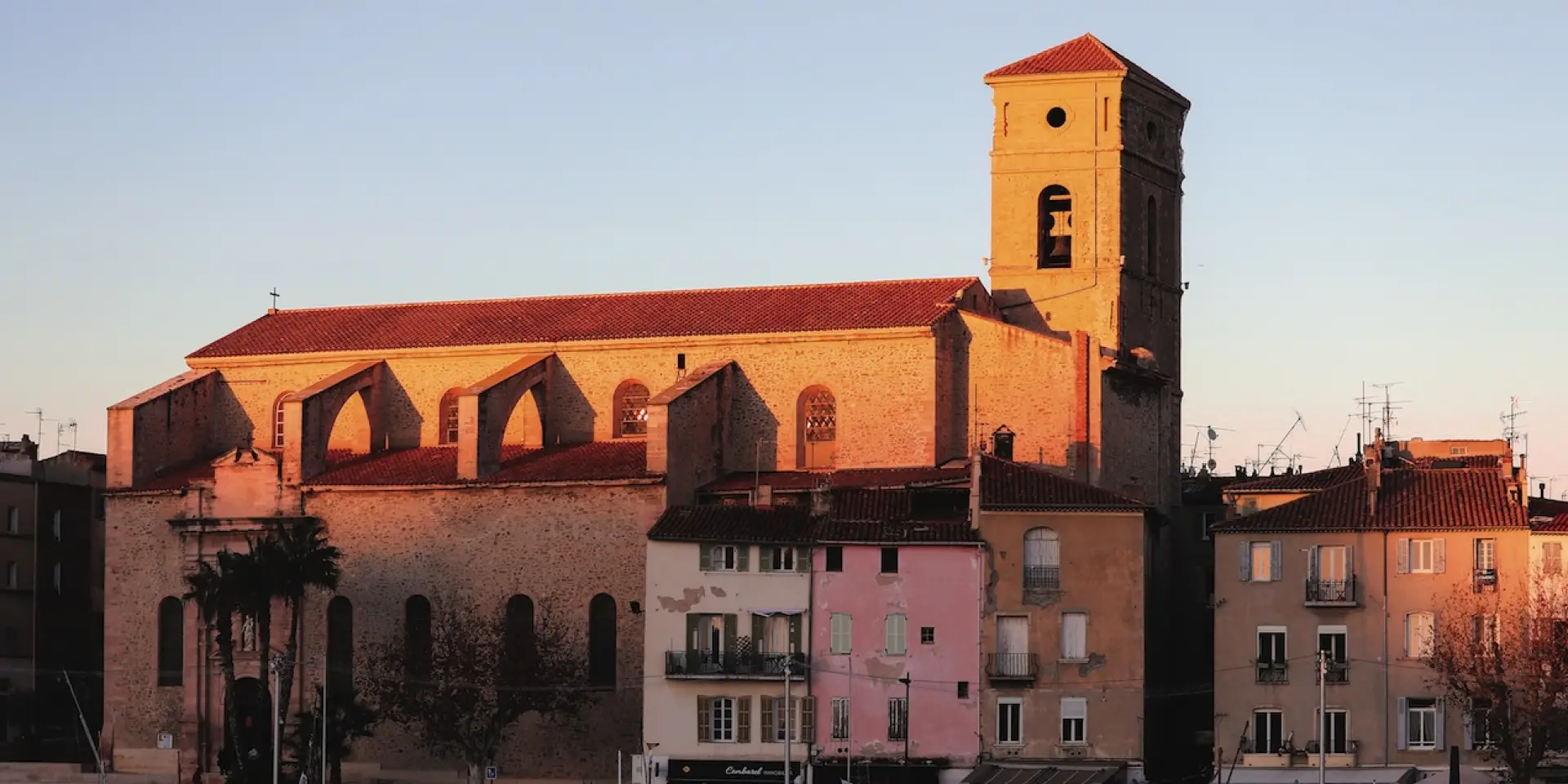
The Church of Notre-Dame de l’Assomption is one of La Ciotat’s most beautiful landmarks. Built between 1603 and 1620 in the Provençal Romanesque style – simple yet imposing – it occupies a central place in the town and in the hearts of the people of La Ciotat. It once stood opposite the old town hall, which is now the Musée Ciotaden.
Inside, the church harbours an unexpected treasure: a statue of Christ erected on Île Verte in 1821, which disappeared during the bombings of 1944, only to be miraculously rediscovered underwater by a fisherman in 1950. Restored thanks to a passionate couple of architects, research carried out as far afield as the Vatican has confirmed that it is a work by Giambologna, the great Renaissance sculptor and pupil of Michelangelo.

Chapel of the Blue Penitents, La Ciotat
Chapel of the Blue Penitents, La Ciotat
The Chapel, built in 1734 by Genoese refugees, is now an exhibition space run by the City. Measuring 62 metres in length, it features a nave with seven bays, a lantern tower topped by a dome, as well as stained-glass windows and gargoyles. It was originally funded by the penitential brotherhoods, Catholic groups dedicated to charitable works. In fact, more than 500 skeletal remains were discovered beneath the chapel during renovation work! On the façade, two penitent figures in prayer still bear witness to this history.

Notre Dame de la Garde Chapel, La Ciotat
Notre Dame de la Garde Chapel, La Ciotat
Built by the Brotherhood of the Blue Penitents, the chapel was consecrated in 1613. Designed in the form of a lateral cross, it was embellished in 1864 with the addition of frescoes and a porch. Its altar, crafted from white Carrara marble, features a carved and gilded oak statue of Notre-Dame de la Garde, donated by the Pénitents Bleus in 1630.
A strategic location for seafaring, the chapel is adorned with some of Provence’s finest maritime ex-votos, testaments to the sailors’ gratitude towards Our Lady of the Guard. It is open to the public during the summer and on 8December, the feast day of the Immaculate Conception, which is marked by a pilgrimage. Although it has been recently restored, its exposure to sea spray still leaves it vulnerable.

From the fully restored Place Esquiros, one can see the chapel’s beautiful stone façade, with its pediment typical of Counter-Reformation architecture. The chapel was built from 1630 onwards on behalf of the Brotherhood of the Black Penitents. Confiscated as national property during the Revolution, it was sold in September 1791. It was converted into a prison during the Federalist period, then passed through various hands before being bought back by Father Brunet, who established the Brotherhood of Saint Anne there, hence its current name.
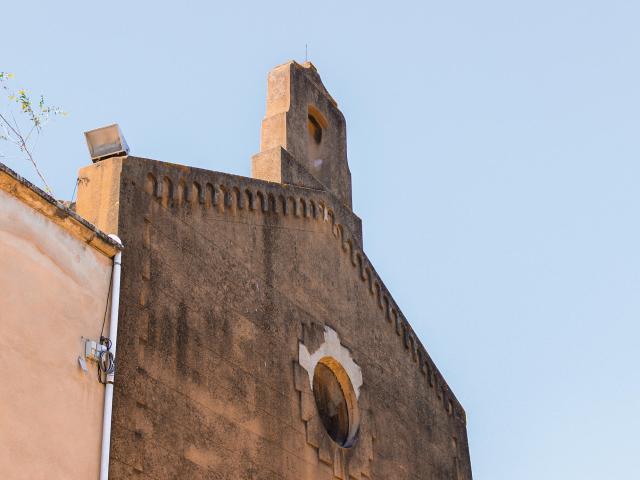
As soon as the Congregation of Saint Anne took up residence in the chapel mentioned earlier, the Black Penitents settled just a few metres away. In 1819, what remained of the Brotherhood gave way to the Congregation of Saint Joseph, and the chapel was dedicated to the saint in June 1821. The statue of Saint Joseph found inside the chapel, which was restored in 1950, is the one that originally stood in the niche above the entrance door.

This chapel, 32 metres long by 6 metres wide, served during the Revolution as the headquarters of the Club des Antipolitiques, a popular society recognised as an affiliate by the centre on Rue Thubaneau in Marseille (1791). The chapel is flanked on either side: to the left, the synagogue, which opens onto the car park (Square Verdun), and to the right, the dance academy, which opens onto the former convent courtyard. Of particular note is the beautifully crafted, three-hundred-year-old door.
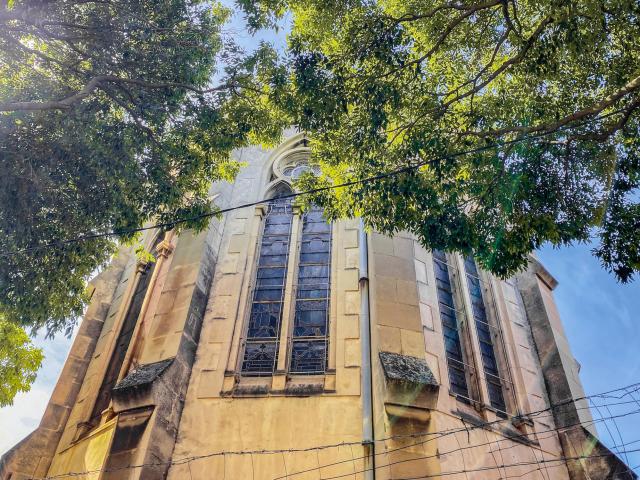
Built between 1866 and 1871, it was inaugurated in 1872. The building is quite large: 26 metres long, 9 metres wide and 14 metres high. The stained-glass windows, of exceptional quality and commissioned in 1867, are the work ofAlphonse Didron, a master glassmaker who also created the stained-glass windows for the cathedrals of Troyes and Soissons.

The chapel was built in 1935 by the Lumière family, who owned the surrounding land. Built in a modern style, it is spacious and light, measuring twenty metres long by eight metres wide, and serves as the place of worship for the beach district. A large courtyard sheltered by reed fencing provides a space for services to be held in the summer.